

Maisie Lloyd
Maisie is the Digital Content Manager at Intelligency, handling all things creative for the agency. Her experience centres around the production of digital content, pertaining to graphic design, writing copy, and video and audio content.
Content chunking is one of the latest terms attributed to the way we structure content, particularly so that it is optimised for AI responses.
Content chunking breaks long-form content down into digestible logical chunks, so it’s easy for the AI to dissect the relevant information. This means shorter pieces of text, listicles, and clearly defined content hierarchies, along with methodical wording in both text and sub-headings to identify the key topics being discussed.
Does my business need to start content chunking?
Content chunking isn’t necessarily a new approach to creating content; in fact, it’s more common than not to accommodate readers with shorter, scannable and ultimately digestible pieces of copy.
However, utilising this approach as a framework for content can be useful if businesses feel it’s in their interest to push their content in AI responses. In some cases, content chunking isn’t suitable for the type of content being produced. For instance, a research paper’s most appropriate format is, as it has always been, a long-form investigation. If it requires context to understand it, then chunking it can remove the necessary detail required to understand the discussion.
Equally, some content can’t be chunked because it’s already short, i.e. FAQs. It can unnecessarily bulk content which does not need it, detracting from its value and reducing its contextual relevance.
The benefits of content chunking include:
- Increased visibility on search engines and AI engines
- Increased chance of click-through rates when people want to explore sources
- Authority is developed with audiences and engines as you’re being ranked higher
- Content becomes more scannable to readers, which can help with engagement
- Content chunking can help make retrospective content updates quicker and easier
What are some examples of content chunking?
Clear Topic Boundaries
Each section should have a specific topical focus, keeping each paragraph to one specific idea. This works in content chunking because it defines different areas of a discussion, making it easier for AI to make the distinction between what is and isn’t contextually relevant.
This ensures each chunk works independently, making it easier for AI and other engines to directly pull into the results
Structural clarity
Utilising formatting to signal different segments, whether that’s through headings and subheadings, bullet points, labelling, and grouping by theme. It creates content that is easier to digest, and makes it clear what it’s trying to achieve.
Consistency in content length
Each chunk should fall between 100 and 300 words each time. Keeping this consistent ensures your content is effectively broken down, splitting it between 1-3 paragraphs.
Each section should ideally be uniform in length, making it easier for the AI to understand what content needs to be retrieved.
Logical entry and exit points
Each section should have a logical beginning and end. Natural conclusions in content chunks are essential for properly breaking down content. It’s important that it doesn’t cut off mid-idea or instruction.
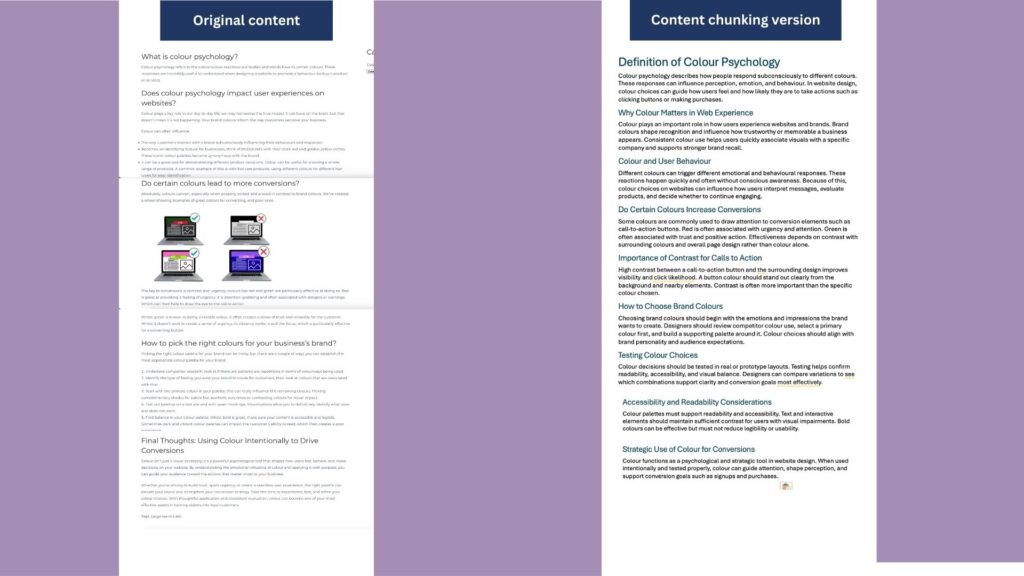
This is how content chunking looks on our blog on colour schemes in branding, before and after.
In summary, content chunking is less about changing what you say and more about improving how you structure it. By organising ideas into focused, clearly labelled sections, you make your content easier for both people and AI systems to understand, retrieve, and reference. Not every piece of content needs to be chunked, but where it fits, this approach can improve visibility, usability, and long-term value. As search and AI-driven discovery continue to grow, clear structure and logical flow will play an increasingly important role in how your content performs.