
Maisie Lloyd
Maisie is the Digital Content Manager at Intelligency, handling all things creative for the agency. Her experience centres around the production of digital content, pertaining to graphic design, writing copy, and video and audio content.
World Intellectual Property Day has rolled around for 2026, and it’s got us thinking about just how much can change within a relatively short period. IP laws are in constant limbo, trying to establish what is and isn’t “fair game”.
One of the latest regulatory points of contention centres around AI. We’re not that shocked. When the discussion around the Studio Ghibli AI generative trend was at its peak, the key argument was about the bastardisation and theft of intellectual property, and the dilution of skill.
IP regulation currently
AI and copyright
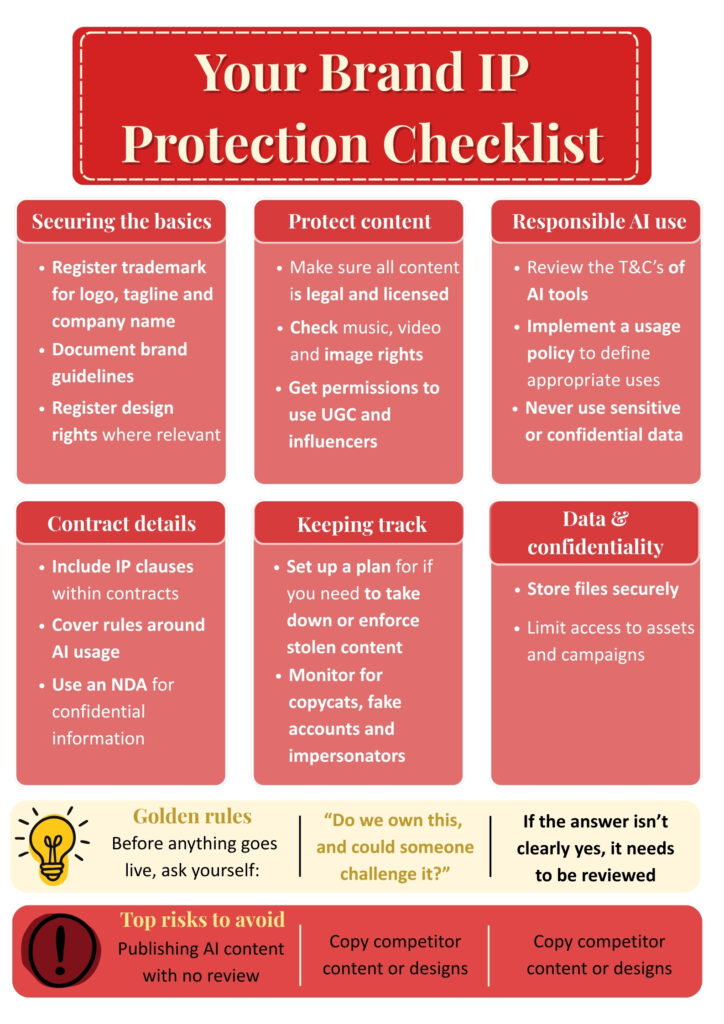
AI copyrighting is still a grey area legally, with no clear ruling yet on whether training AI with copyright content is evidence of infringement. We see this in cases like Getty vs Stability, where there’s yet to be a definitive ruling for or against such approaches. That leaves a lot of room for questions for marketers, like, is it ok to use AI in my content?
The only clear answer we can give so far is that it can’t be assumed that AI content is legally safe. AI can and may utilise protected IP of other brands to generate visual elements, copy or ads. The impacts aren’t fully understood yet, which means brands using AI could trigger legal disputes later down the line. Some of the other risks it potentially brings on are:
- Loss of ownership
- Data leaks
- Damaging trust and authenticity
- Loss of IP
- An unknowing use of protected assets and ideas.
AI clauses in contracts
The rules around business use of AI are becoming more stringent, requiring closer attention to be paid to the contracts being signed and the terms of use you agree to. The kinds of stipulations that can be found in some of these contracts include:
- Who owns the AI-generated content
- Liability for IP infringement
- Whether your data will be reused
Copycat branding to be penalised
Brand assets are better protected now than ever before in some cases. Brands can no longer copy along just because it worked for another brand. Specifically, when brands don’t adapt their content or assets to reflect their own branding, this dupe approach is now much riskier.
We see this happen time and time again in the UK courts with cases like Aldi vs M&S and the Thatchers vs Aldi case, which again ruled in the appellants’ favour.
Increased costs for IP and Trademarking
For the first time since 1998, on April 1st, the UKIPO has increased the cost to trademark and claim intellectual property by an average of 25%. With a stronger push for brands to select and prioritise what it is they want to protect.
This means you can’t just trademark anything; instead, there needs to be a stronger focus on core brand assets, protecting your name, logo and key campaigns created. High-value content, now more than ever, is protected when distinguishable with the unique elements of a brand’s IP.