
Maisie Lloyd
Maisie is the Digital Content Manager at Intelligency, handling all things creative for the agency. Her experience centres around the production of digital content, pertaining to graphic design, writing copy, and video and audio content.
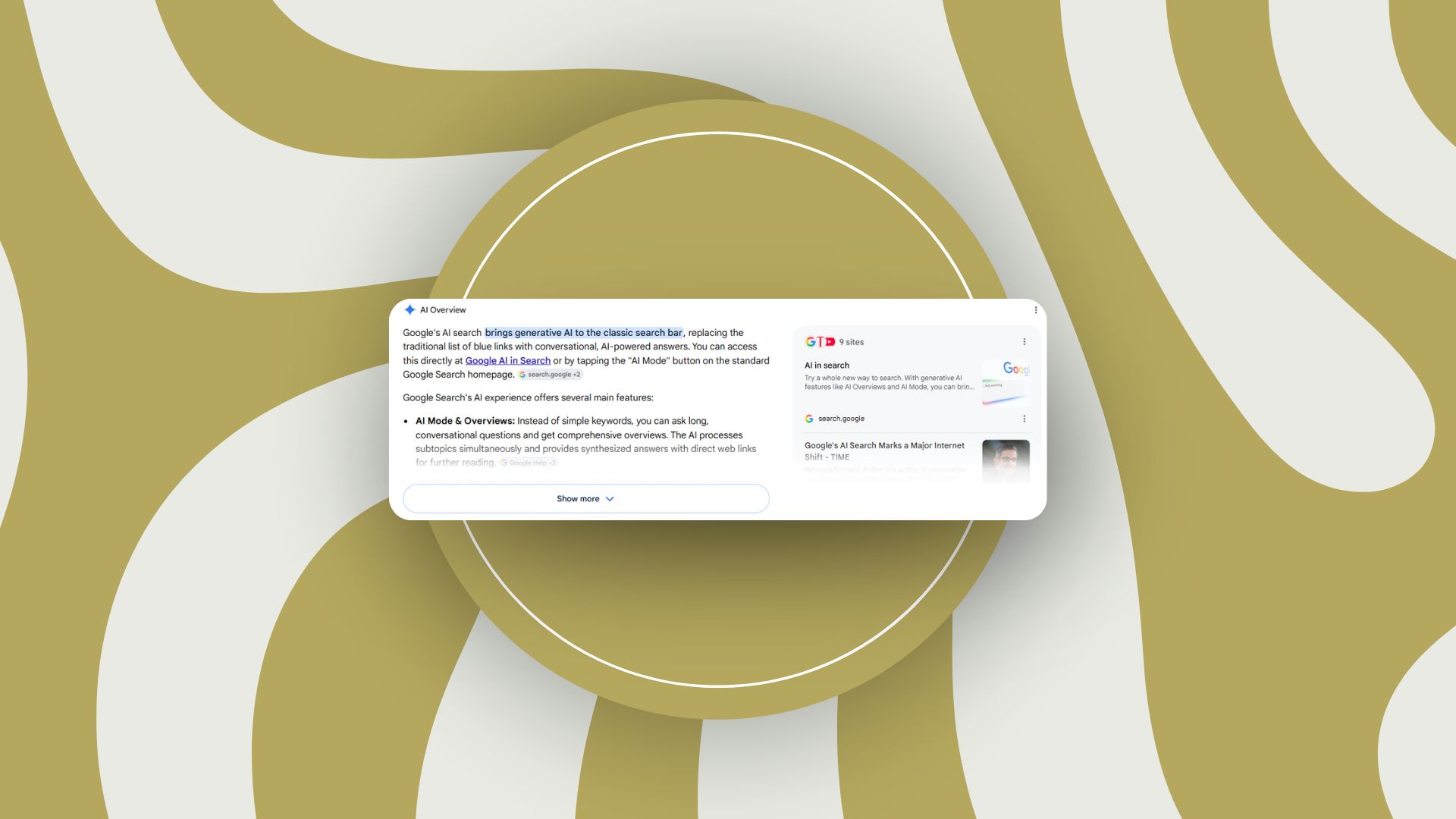
AI overviews, FAQ blocks and AI mode are each increasingly being displayed across the search engine results page. We have to ask the question: is it diluting the quality of content, and is it dominating the SERP, making organic content increasingly harder to find?
We see a plethora of AI uses, ranging from AI-generated search experiences (where AI creates or summarises information) and AI-assisted search features (where AI helps rank, organise, or present content).
Places AI is currently used on search engines
Google, Bing and Yahoo
Google is known for leading the race with a staggering 91.27% of traffic in comparison to other well-recognised search engines. Recognised for its cutting-edge updates, its fine-tuned algorithm and vast catalogue of websites and content to serve searchers’ queries.
In its journey to be the best and largest of search engines, AI has become a key and defining feature. With a strong presence across various search results features, it’s absolutely reshaping the way Google works.
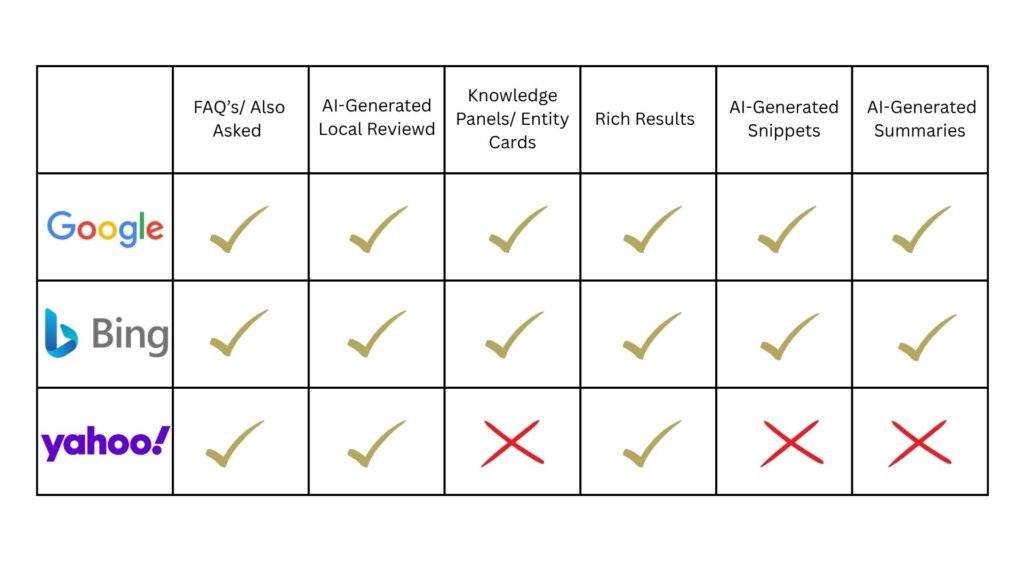
We’ve observed the same evolution across other search engines, including Bing and Yahoo. Those features include:
The Impact of AI on organic content
AI-generated content doesn’t need to fight to be spotted; now, the first positions across the SERP are completely dominated by AI results, pushing organic content further down and reducing the chance of discoverability and clicks.
The AI Zero-clickopalypse
One of the most harmful impacts of AI-generated results is the zero-click epidemic, where AI content steals the valuable clicks from organic content on the SERP. When users don’t need to click into content, because AI has borrowed and displayed it at the top of the SERP, it directly steals traffic from those cited sites.
Ultimately, AI features are pushing the higher-ranking organic pieces of content below the fold, shrinking visible organic listings.
The consequence for a zero-click search varies. For more established brands and sites, reduced clicks may be inconsequential, while smaller brands building their content portfolio are more likely to suffer as a result, seeing the following metrics affected:
- Organic traffic
- Click-through rates
- Page sessions
- Average duration of engagement
Shifting approaches from SEO to AEO
The entire strategy for SEO needs to adapt to AI Engine Optimisation (AEO). This changes the style, nature and focus of content, as well as the perspectives marketers use to produce it. The impact then falls on human users, who are increasingly likely to encounter more generic, factual content that doesn’t necessarily offer a human experience or perspective.
Rather than allowing users to research and draw their own conclusions, AI is serving cookie-cutter, generic content that reinforces confirmation bias, reduces searchers’ critical thinking, and stunts what was once curiosity, replacing it with quick, low-value information retrieval.
Algorithms creating personalised SERP’s
Previously in SEO, when your content ranked, it would be a specific keyword it ranked for, and that was applied to all other sites using the same keyword. Now, personalisation breaks down that method of ranking, with results based on contextual clues like gender and location.
Content now tends to be displayed based on location, not a national or global ranking. Google also takes context from search history, inferring intent and resulting in more tailored responses, with historical searches influencing the type of results shown. Ranking has transitioned from a fixed metric to essentially a range in which you can get a general idea of performance.
So, is AI diluting the quality of content on the SERP?
The short answer is yes, but it’s not quite that simple. AI is reshaping the SERP in ways that make organic content harder to find, harder to click, and harder to rank consistently. The zero-click reality, the shift from SEO to AEO, and the fragmentation of personalised results all point in the same direction: the traditional organic search landscape is shrinking.
But dilution isn’t the same as destruction. The opportunity now sits with content that AI can’t easily replicate original research, genuine human perspective, authoritative expertise, and experiences that feel lived rather than generated. If AI serves the generic, the specific becomes more valuable.
The question isn’t whether AI is diluting quality. It’s whether we’re willing to create content that stands apart from what AI can summarise.